
For both men and women who have limited sexual knowledge or experience, it’s not uncommon to think that squirting is something that only happens in adult videos.
You might think:
“Isn’t that just something from porn?”
However, to be clear:
Depending on individual physiology, women can squirt.
And importantly:
Squirting and orgasm—what people often call “cumming”—are fundamentally different.
Our salon, Lips, specializes in helping women who want to experience Vaginal Orgasm, and we receive many applications from women seeking that experience.
Among these women, some end up squirting after achieving a Vaginal Orgasm.
To be more specific, when I—h-i, the representative of Lips—interact with applicants:

This is the kind of state where I can make her squirt.
If I judge that way, I may intentionally induce squirting (laughs).
However, the squirting that occurs at that moment is neither a clitoral orgasm nor a Vaginal Orgasm.
Most women who apply to Lips experience squirting or orgasm for the first time during our sessions. As a result, it’s common for them not to fully understand what is happening in their bodies while experiencing these sensations.
That said, this kind of situation is not limited to our applicants—many women may experience similar confusion in their everyday sexual lives.
So, in this article, we will explain the differences between squirting and orgasm in detail, based on expert research and findings.
Physiological and Sexual Responses in the Female Body

In the past, information about sexual pleasure was limited to books, magazines, and videos—and these were often biased toward a male perspective.
The culture of exploring sexual pleasure wasn’t as developed as it is today.
However, times have changed. With the rise of the internet and increasing respect for female sexual diversity, access to information has expanded significantly.
Thanks to the spread of “real voices” and “evidence-based knowledge,” many aspects of female sexual pleasure that were once vague and abstract have become clearer.
With that in mind, let’s first look at the physiological and sexual phenomena that occur in the female body.
Squirting
First of all, the primary component of female squirting fluid is urine.
Many studies have shown that it often contains a small amount of secretion from the Skene’s glands (often referred to as the female prostate).1
This has also been reported in a 2022 study by Okayama Central Hospital.
The fluid is typically clear and watery, and it is expelled from the urethra—making its properties similar to urine.
It also seems to dry quickly even when a large amount gets on sheets.
There are individual differences among women, but some may squirt involuntarily and not even realize it.
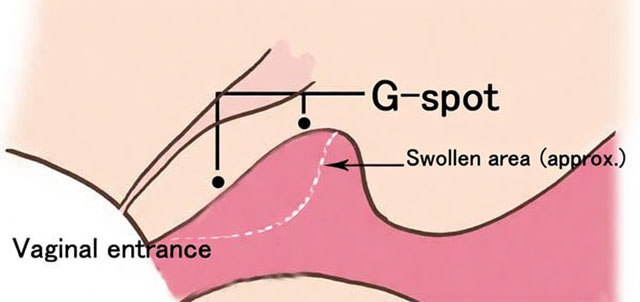
When squirting is triggered by finger stimulation, it is often caused by stimulation around the G-spot.
Before squirting, the area around the G-spot may swell, and some women feel a sense of fullness. See the image below.
Generally, squirting does not accompany orgasm.
From my experience with past applicants at Lips, it was rare for women to squirt simultaneously with a Vaginal Orgasm or clitoral orgasm.
Orgasm
Both types are triggered when pleasure and sexual arousal reach their peak.
However, the nature and duration of pleasure differ.
With a clitoral orgasm, pleasure typically subsides after climax.
With a Vaginal Orgasm, pleasure can continue intermittently even after climax, allowing for multiple orgasms.
For more details on the differences:

Female Ejaculation
Some people may be surprised and ask, “Do women ejaculate?”
In some cases, a small amount of milky fluid—different from urine—is released from the Skene’s glands.
Unlike squirting, this fluid is not expelled in large quantities, so it often goes unnoticed.
It is typically released before, during, or after a Vaginal Orgasm.
In women who can achieve Vaginal Orgasm, it can sometimes be confirmed by carefully observing the vaginal area after using a vibrator or dildo.
In the past, female ejaculation was often confused with squirting.
However, modern research distinguishes the two as separate phenomena. Studies have shown that the composition of female ejaculate differs from squirting fluid.2
In Japan, the impact of adult videos tends to emphasize squirting.
Meanwhile, in countries where sex education and sexual science are more established, female ejaculation has been recognized for nearly 40 years.3
Another reason it is less recognized in Japan is the lack of widespread knowledge about the Skene’s glands and the female prostate.
Differences Between Squirting and Orgasm

Some inexperienced men mistakenly believe that:
“Squirting = Orgasm”
However, as explained earlier, they are fundamentally different.
Even in adult videos where squirting is often used as a performance element, it’s rare to see scenes where a woman is squirting and simultaneously screaming in orgasm.
This is because squirting does not necessarily involve pleasure.
Let’s break down the differences in detail.
Physiological vs Sexual Phenomena
Squirting does not occur simply because something feels good or because a woman reaches orgasm.
Likewise:
Just because a woman squirts does not mean she has reached orgasm.
They are completely different physiological and sexual responses.
Squirting can occur purely from stimulation, regardless of pleasure. It is closer to a physical reflex than a sexual climax.
Pleasure varies greatly between individuals.
In contrast, during orgasm, women clearly feel pleasure reaching its peak, often accompanied by involuntary body contractions.
During a Vaginal Orgasm, some women even experience intense muscle spasms due to overwhelming pleasure.
Orgasm is clearly a sexual phenomenon.
Mental vs Physical Pleasure
Rather than orgasmic pleasure, it is often described as:
“A release-like sensation”
Similar to finally being able to urinate after holding it for a long time.
At Lips, when we ask women who can both achieve Vaginal Orgasm and squirt about their experiences, they consistently say:
“It feels better when I orgasm internally.”
Some women experience what is called “orgasmic squirting,” where they squirt during a Vaginal Orgasm.
For example, the woman in the following story is one such case:

As described in that story, she experienced intense Vaginal Orgasm while soaking the sheets with squirting.
Risks of Squirting
Many women want to learn how to achieve Vaginal Orgasm out of curiosity about experiencing continuous pleasure.
A smaller number also want to learn how to squirt.
However, developing the ability to squirt comes with risks.
There is also a risk of developing a habit of squirting during Vaginal Orgasm.
It’s important to understand that squirting involves risks both before and after learning how to do it.
Summary
Both squirting and orgasm vary greatly depending on the individual woman.
Through my work at Lips, I truly feel this.
Some women can squirt but cannot achieve Vaginal Orgasm.
Others can achieve Vaginal Orgasm but do not squirt.
Both can become sources of concern.
What can be said is:
While orgasms (including clitoral and Vaginal Orgasm) represent a peak of pleasure and sexual release, squirting does not necessarily do so.
Neither is “more correct” than the other.
Female sexual pleasure is highly diverse and unique.
Understanding this diversity is essential when exploring both orgasm and squirting.
References
- Enhanced visualization of female squirting ↩︎
- The Female Prostate Revisited: Perineal Ultrasound and Biochemical Studies of Female Ejaculate ↩︎
- The G Spot and Other Recent Discoveries About Human Sexuality ↩︎
Notes
1・This section references research data published in 2022 by Okayama Central Hospital. By visualizing the movement of fluid inside the body during squirting, the study suggests that the primary component of squirting is urine, with possible mixing of secretions from the Skene’s glands. This research was also published in the official journal of the Japanese Urological Association, International Journal of Urology.
2・This section is based on literature produced by a research team consisting of Austrian urologists and clinical researchers specializing in female urology and sexual medicine. The study examines the existence and function of the Skene’s glands (commonly referred to as the “female prostate”) using ultrasound imaging and biochemical analysis. It confirmed that female ejaculate contains high concentrations of PSA, PAP, fructose, and glucose.
3・This section references a book first published in 1982, written by sexology researchers such as Alice Kahn Ladas (then Ed.D. at Columbia University) and Beverly Whipple (then a professor at Rutgers University, now Professor Emerita). The book is known for introducing new perspectives on female sexual pleasure, particularly by popularizing the concepts of the “G-spot” and “female ejaculation.”