
There are many ways women experience sexual pleasure, but when it comes to orgasm, they are generally divided into two main types:
For most women, a clitoral orgasm is something they have experienced through masturbation or external stimulation.
However, a vaginal orgasm remains unfamiliar or unexperienced for many women.
At our sensual wellness studio LIPS, we receive applications every single day from women who say:

I want to experience a Vaginal Orgasm.
The difference in pleasure between a clitoral orgasm and a vaginal orgasm is not subtle—it’s as distinct as the difference between sweetness and umami.
For women who want to experience a vaginal orgasm, understanding what that pleasure actually feels like is naturally a major point of curiosity.
On this page, we introduce real testimonials from women who applied to LIPS and were able to experience a vaginal orgasm through sensual bodywork performed by me, h-i, the founder of LIPS.
By sharing their firsthand experiences, we explain:
If you want to understand the real sensation of a Vaginal Orgasm, this article will be especially helpful.
Why Vaginal Orgasms Are Often Described as “Intensely Powerful” on Social Media and Online

With the rise of social media and female-oriented erotic content, you may have come across descriptions such as:

My whole body started convulsing

My mind went completely blank and floated away
It felt so good I almost passed out
You’ve probably seen these kinds of expressions before.
The truth is:
They are half accurate—and half misleading.
There are two main reasons for this.
Differences in Vaginal Erogenous Zone Development
First, the intensity of pleasure varies depending on how developed the vaginal erogenous zones are—in other words, experience.
When women first begin to recognize vaginal orgasm sensations, the pleasure is often shallow and vague—something like:
I think I kind of get it…
As experience accumulates, the pleasure tends to become deeper, stronger, and longer-lasting.
Subjective Differences in Sensation
The second reason is simple: sexual pleasure is highly subjective.
To put it another way, let’s compare it to food.
Imagine a dessert that’s gone viral on social media.
Some women will eat it and say:
- “This is incredible!”
- “It’s pretty good.”
- “I don’t get why everyone’s so excited.”
Pleasure works the same way.
Ultimately, how a vaginal orgasm feels can only truly be understood by the woman experiencing it herself.
However, listening to real women describe their vaginal orgasm experiences can help women who are inexperienced—or only vaguely aware of the sensation—recognize it when it happens.
Real Experiences from Women Who Have Had Vaginal Orgasms

That’s why, from here on, we introduce women who applied to LIPS and shared their honest impressions of:
The intensity of their vaginal orgasms
What they felt at the moment
These testimonials may help you think, one day:
“Oh… this must be it.”
They are valuable insights from women who experienced vaginal orgasms before you.
As you read, pay close attention to the differences between clitoral orgasm and vaginal orgasm.
“It Felt Too Good—Almost Unreal”
The woman featured in the video above originally had a strong libido but struggled because she could not experience a Vaginal Orgasm.
After discovering LIPS, she applied immediately.
When asked about the sensation, she said with surprise:
You can read her full experience article at the link below.

“It Felt So Good I Almost Passed Out”
This woman already showed signs of being close to vaginal orgasm before applying, but through this experience, she was able to fully recognize and feel its intensity.
She also talks about her body trembling continuously as waves of pleasure washed over her, reaching near-unconscious levels.
Her description of the **post-orgasm state—‘a blank, spaced-out mind’—**is especially memorable.
You can read her full experience here:

“Completely Different from a Clitoral Orgasm”
She eventually got married and came to believe that reaching a vaginal orgasm with her partner was impossible.
That’s when she applied to LIPS.
In just one day, she was able to experience a deep, overwhelming vaginal orgasm—nearly to the point of fainting.
Her full story is available below.

“Something Rose Up and Overflowed”
What’s clear is that the pleasure was intense.
You can read her experience article here:

Summary of These Experiences So Far
While “it felt good” is a common theme, looking more closely reveals that each woman’s experience is uniquely different.

Bringing women into this kind of vaginal orgasm state through internal erogenous zone development is honestly very easy for me.
Some women who applied to LIPS were already experiencing vaginal orgasms without realizing it.
As a result, women may already be orgasming vaginally but think:
“This can’t be it.”
Some women only realize they’re having vaginal orgasms after experiencing LIPS.
Key Differences Between Vaginal Orgasm and Clitoral Orgasm

When searching online for information about vaginal orgasm pleasure, you’ll quickly notice that there is too much information?often contradictory.
This overload can leave women thinking:
“I don’t know what’s actually true anymore…”
For women who genuinely want to experience a Vaginal Orgasm, this confusion can become a negative cycle.
After each LIPS session, I always ask the women about the sensations they experienced.
As you can see from the testimonials introduced earlier, their answers vary widely in both intensity and expression.
That said, there are clear physiological and experiential differences between vaginal orgasms and clitoral orgasms.
Below, we explain those differences in a concrete and easy-to-understand way.
Multiple Orgasms Without a Cool-Down Phase
If we were to visualize the pleasure intensity and duration of a clitoral orgasm, it would look something like this:
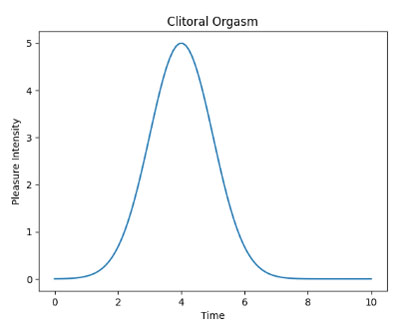
As the graph suggests, pleasure rises sharply until climax—and then drops suddenly.
After a clitoral orgasm, some women experience a state similar to the male refractory period, often referred to as a “cool-down” or exhausted feeling.
No matter how much stimulation continues, pleasure often does not return easily.
Vaginal Orgasm Is Different
With a Vaginal Orgasm, pleasure does not abruptly collapse after climax.
Instead, orgasmic sensations come in rolling waves, one after another.
The type of pleasure itself is also different from that of a clitoral orgasm.
If we graph vaginal orgasm pleasure, it looks like this:
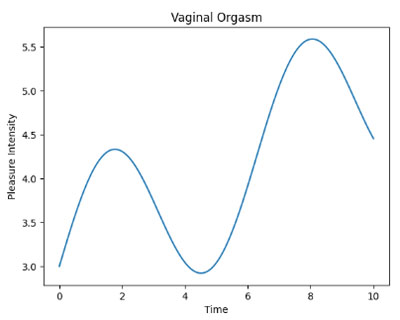
As shown above:
- Pleasure builds gradually
- Reaches levels far beyond clitoral orgasm
- Returns repeatedly in waves
As long as internal stimulation continues, these waves can feel almost endless.
Even after stimulation ends, many women report lingering waves of pleasure that slowly fade, leaving a long-lasting afterglow.
Deep, Long-Lasting Pleasure
A clitoral orgasm often feels like:
“It came?and then it was gone.”
In contrast, once a vaginal orgasm begins, pleasure lingers and deepens over time.
Even from an observer’s perspective, vaginal orgasms clearly look more pleasurable
As internal erogenous zones develop, stimulation near the cervix—known as the Portio area—can trigger even deeper pleasure, sometimes leading to a trance-like state.
When the Portio becomes an active erogenous zone, some women experience continuous, repeated orgasms without interruption.
We explain how to develop the Portio as an erogenous zone in detail in the related article below.

A Sense of Deep Happiness and Emotional Fulfillment
Clitoral orgasms are typically achieved through continuous external stimulation, such as fingers or vibrators.
Vaginal orgasms, on the other hand, are most commonly experienced during penetrative sex, where climax occurs while being thrust into.
During solo play, women often use a dildo or vibrator for vaginal orgasms.
One unique feature of vaginal orgasms is the possibility of simultaneous climax with a partner, creating a powerful sense of unity and emotional bonding.
Many women describe this moment as feeling “at one” with their partner.
Endorphins, in particular, are known for their pain-relieving effects and ability to induce strong feelings of happiness and well-being.
They are often referred to as “happiness hormones.1
As a result, many women report a soft, dreamy feeling?described as “floaty” or “warm”?that continues long after the orgasm itself.
Pleasure That Comes From the Brain
Both the sensation of climax and the feeling of pleasure originate in the brain.
A Vaginal Orgasm, in particular, is a type of orgasm that cannot be reached unless the brain genuinely recognizes the experience as pleasurable.2
Common descriptions found online include:
My mind went completely blank
I couldn’t think about anything
My body felt light, like it was floating
These experiences are signs that pleasure is being processed at a deep neurological level through brain chemistry.
Beyond physical pleasure, vaginal orgasms also provide emotional benefits and positive effects on mental and even aesthetic well-being.
Feeling happy, deeply satisfied, and more confident—what could be better?
Two Types of Vaginal Orgasm Pleasure

For most women, recognizing a Vaginal Orgasm doesn’t happen suddenly.
More often, it begins as:
“I think I kind of feel it…”
In many cases, women who are just beginning to understand vaginal orgasm sensations are experiencing G-spot?based vaginal orgasms.
As familiarity increases and the deeper areas of the vagina become pleasurable, the Portio can develop into a powerful erogenous zone, allowing women to experience much deeper sensations.
Let’s look at each type more closely.
Vaginal Orgasm Through G-Spot Stimulation
The G-spot is an erogenous zone that typically requires development and familiarity to function as a source of vaginal orgasm.3
For this reason, a woman’s first Vaginal Orgasm is almost always G-spot–based.
Vaginal Orgasm Through Portio Stimulation
Portio-based vaginal orgasms are considered advanced-level experiences.
In most cases, women cannot recognize Portio pleasure unless they already clearly understand the pleasure of G-spot vaginal orgasms.
Think of Portio stimulation as the next stage.
Because the Portio is located near the cervix, it lies much deeper than the G-spot.
Not all women can experience Portio-based vaginal orgasms.4
However, for those who can, the pleasure intensity can be overwhelming.
Descriptions often seen online—such as:
My body convulsed uncontrollably
It felt so good I lost consciousness
—are most commonly associated with Portio-based vaginal orgasms.
With further development, some women can even climax from stimulation of non-genital areas such as the neck, nipples, or ears.5
Conclusion
While individual differences certainly exist, vaginal orgasms and clitoral orgasms differ clearly in:
- Type of pleasure
- Depth of sensation
- Number of climaxes possible
From a purely experiential standpoint, vaginal orgasms often feel far more “rewarding.”
It’s true that vaginal orgasms are more difficult to achieve than clitoral orgasms.
Because of that, the difference in pleasure can feel dramatic.
However, being too fixated on vaginal orgasms—or holding exaggerated expectations—can actually prevent women from recognizing them when they occur.
Some women are already experiencing vaginal orgasms but mistakenly think:
“This can’t be it.”
When that happens, vaginal orgasm becomes harder—not easier—to reach.
Developing vaginal orgasm sensations alone can be difficult.
Having an experienced partner guide stimulation changes:
- The emotional context
- The level of arousal
- The depth of sensation
As a result, pleasure can feel twice as intense or more, making vaginal orgasms much easier to recognize.
Even women who can technically experience vaginal orgasms—but feel unsure whether they truly are—often gain clarity through a LIPS experience.
If you want to understand your body more clearly, applying to LIPS is one possible option.
>>Click here to apply for Lips’ sensual massage for women
We also share messages of appreciation sent directly to me, h-i, from women who applied to LIPS.
With their permission, screenshots from messaging apps are published within agreed limits.
Some women share heartfelt reflections on their vaginal orgasm experiences, while others comment on my personality and approach.
If you are considering applying to LIPS, these voices may help you decide.

References
This article incorporates expert research and third-party studies on female orgasm from medical and academic sources.
- Bridging Pleasure and Mental Well-Being: The Impact of Female Orgasm on Anxiety and Depression ↩︎
- Activation of sensory cortex by imagined genital stimulation: an fMRI analysis ↩︎
- Ostrzenski, A. (2012). G-spot anatomy: new discovery. The Journal of Sexual Medicine. ↩︎
- Jannini, E. A., et al. (2014). Beyond the G-spot: clitourethrovaginal complex and female orgasm. ↩︎
- Unlike Men, Women Have a Remarkable Variety of Orgasmic Experiences ↩︎
Notes
1・This medical review discusses how female orgasms may reduce anxiety and depressive symptoms through neurological mechanisms.
2・fMRI research shows that imagining sexual stimulation activates the brain similarly to physical touch, suggesting pleasure originates in the brain.
3・Research indicates that women with higher nerve density and blood flow in the G-spot region may experience vaginal orgasms more easily.
4・Sexology research from the University of L’Aquila reports individual differences in nerve density and structure of the Portio region.
5・A review by researchers at Concordia University suggests orgasms may occur through stimulation of non-genital areas.