
Developing internal vaginal erogenous zones is essential for experiencing internal orgasms — a point I’ve covered in other articles. The most important area to focus on is the G-spot.
As the founder of the women-only clinic Lips, I’ve guided more than 500 women to experience internal orgasms through hands-on sessions. During those treatments I frequently and often unconsciously work on stimulating and developing the G-spot.
I believe that deliberate stimulation and training of the G-spot are crucial building blocks for helping many women reach internal orgasms.
Because our trial sessions at Lips last only one day, many women don’t reach orgasm during that single visit. For women who don’t succeed in that session — or who contact us later by email — I provide concrete G-spot training methods they can use during masturbation, along with practical tips and precautions to help them work toward internal orgasms.
On this page I’ll explain, in clear and repeatable steps, how to find and train your G-spot.

I want to learn where the G-spot is and develop the ability to achieve orgasms through penetration!
If you want to learn how to locate your G-spot and train it so you can experience internal orgasms on your own, this guide is designed to give you a helpful push in the right direction. Please read on and try the suggestions that feel right for you.
What is the G-spot? My perspective on its location
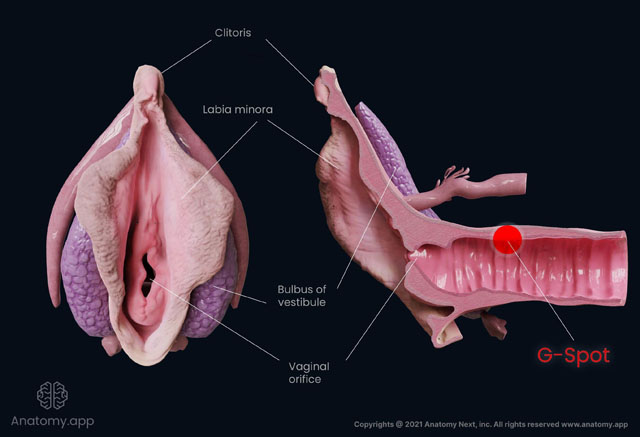
Anatomy.app1
First, I’ll share my personal observations as the founder of Lips (h-i).(See the diagram below.)
The G-spot is generally located on the belly-side (anterior) wall of the vagina, roughly 2–5 cm in from the vaginal opening. It’s not a region you can see with the naked eye. Because internal anatomy varies from person to person, the diagram above should be treated only as a general example.
In some women the G-spot sits deeper; in others it is closer to the entrance.

Even I sometimes find it difficult to pinpoint the exact location.
Training the G-spot through regular masturbation is an effective approach. I’ll introduce specific methods in the next sections — developing the G-spot can open the door to internal orgasms.
You may wonder how long it takes to develop the G-spot sufficiently to achieve internal orgasms.
How long will it take to be able to have an orgasm through penetration?
There’s wide individual variation. It’s impossible to promise a fixed timeline. What I can say for sure is that training the G-spot prepares your body and brain for internal orgasms. Reaching internal orgasm is rarely instantaneous — it typically requires time and consistent practice.
From my experience guiding over 500 women at Lips through sensual massage and toward internal orgasm, I can confidently say that the “barrier” to internal orgasm can feel large for those who’ve never reached it before.
Consistency is key. Don’t miss the small changes in sensation that show progress.
Current research and expert views on the G-spot
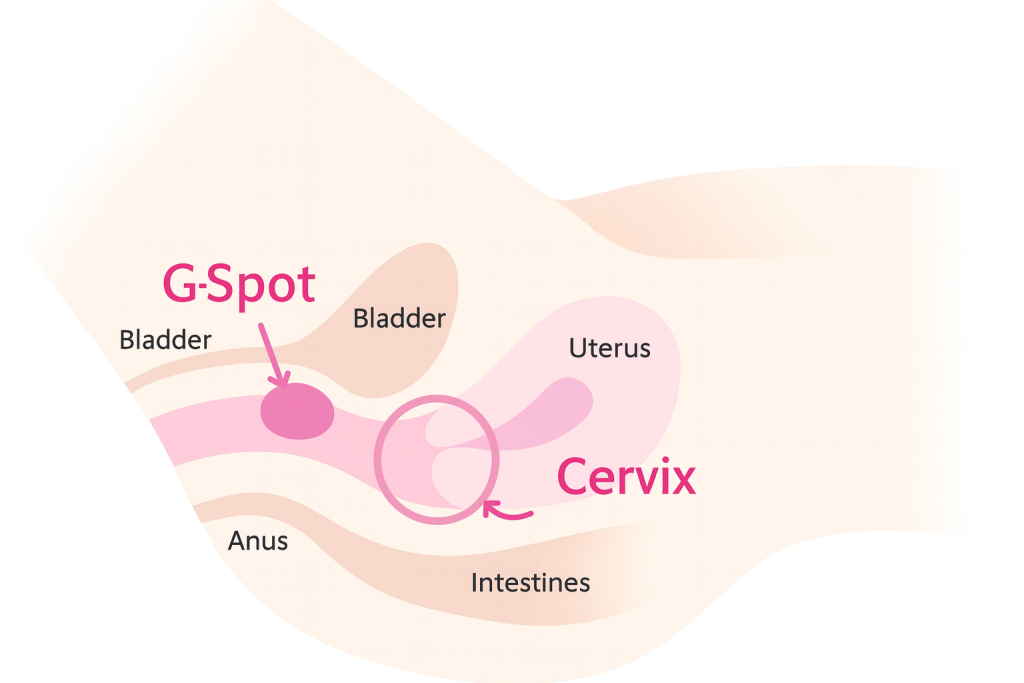
Anatomical sources sometimes indicate the G-spot region lies about 5–8 cm from the vaginal opening (marked on the diagram). That range is cited in overseas literature and is reasonable as a general guideline.
Researchers at Anatomy.app — the source for the diagram above — report survey findings about women’s awareness of the G-spot and sexual response to stimulation. Their data indicate:
35%–60% of women report pleasurable sensations from the G-spot and consider it an important contributor to internal orgasms.
In Japan it’s often said that fewer than 70% of women can experience internal orgasms, so these findings are interesting and relevant.
Some anatomical studies also report higher blood flow and nerve density in the anterior vaginal wall (the G-spot area), which supports the possibility of a structural basis for G-spot sensitivity.2
At the same time, there are researchers who argue the evidence is insufficient to definitively claim the G-spot is a distinct anatomical structure.

There is not enough objective data to confirm its existence.
Others hold the opposing view:

The G-spot exists and plays an important role in orgasm
So the scientific community remains divided, and the debate continues. Because of natural individual differences in anatomy, no single definitive proof has emerged.
That said, some studies report up to 60% of women acknowledging G-spot-related pleasure and internal orgasms in surveys.
A systematic review that analyzed 31 studies has attempted to summarize the existing evidence on whether the G-spot exists and where it might be located.3
If you want to dig deeper, please check the references listed at the end of this article.
For the purposes of this blog and the Lips clinic, I will explain the G-spot from the perspective of a practitioner who believes it can be a functional erogenous zone and a helpful target for training.
Step-by-step guide to training the G-spot

Only about 30% of women report having experienced an internal orgasm — considerably fewer than those who are likely able to orgasm from clitoral stimulation alone.
Women who do manage internal orgasms often describe the quality of sensation as very different from clitoral orgasms: once they experience it, some say it becomes addictive and makes sex more enjoyable.
Many women may secretly wish to experience an internal orgasm at least once in their life.
I would like to experience an orgasm from penetration at least once in my life!
In my view, training the vaginal G-spot to function as an erogenous zone is a necessary step toward achieving internal orgasms. With that assumption in mind, I’ll now walk you through detailed and practical methods for G-spot training.
Understanding the Exact Location of Your G-Spot
To start developing your G-spot sensitivity, you first need to know its exact location.
Let’s take another look at the image of the G-spot position I showed earlier.
It’s located on the front (belly-button side) wall of the vagina, just a few centimeters inside the entrance.
How deep it is—whether it’s around your second knuckle or closer to the base of your finger—depends on the length of your fingers, so there’s naturally some variation.
If you’re not familiar with exploring your body yet, finding it by yourself can definitely be tricky.
In my case, when I insert my finger to somewhere between my second knuckle and the base, I gently press the fingertip upward toward the belly button to search for the woman’s G-spot.
Based on my finger length, the depth is roughly between my second knuckle and the base.
This is just an average reference?of course, this varies from person to person.
The texture also differs from woman to woman.
Some describe it as:
From my experiences with more than 500 women, many tend to have a “soft, cushion-like” texture in that area.
If a man has some experience, he can often locate the G-spot with just one insertion of his finger.
When a woman’s body is already somewhat developed in this area and I find the spot quickly, her reactions are usually:
If you feel something like a slight urge to pee, that’s actually a very good sign?it usually means the location is correct.
And don’t worry: that sensation is completely normal and not harmful at all.
If you haven’t developed much sensitivity yet, you might feel nothing at first.
Even if you explore yourself smoothly, whether you feel pleasure or not can change depending on:
Because all of these factors are involved, it’s honestly pretty difficult to find your G-spot using only your own fingers.
And if you rely on a male partner, he needs some level of experience and dexterity with his fingers.
So take your time.
Think of it like:
“If I can’t find it today, I’ll just try again next time.”
If you’re the type who doesn’t get very wet even when aroused, you may want to use a vaginal moisturizing gel.
Of course, the ideal state is when your own natural lubrication keeps everything slippery and comfortable.
Use a Vibrator That Can Stimulate the Clitoris
Because the G-spot is located on the front (belly-button side) wall of the vagina, keeping your finger inside for continuous stimulation can be physically uncomfortable and make it hard to focus on G-spot development.
In this case, I recommend a vibrator that also has a clitoral stimulator—sometimes called a “clit-vibe.”
Why I suggest a clitoral stimulator: recent research shows that the clitoris is not only involved in vaginal orgasms but its internal structure overlaps with the G-spot area.4
If the clitoris is part of the G-spot, it kind of blows the concept of an “internal orgasm” wide open—but in my experience, combining clitoral and vaginal stimulation is very effective for achieving internal orgasms.
Also, for beginners, adding clitoral stimulation helps increase pleasure while getting used to internal stimulation.
Choose a vibrator shape that fits your body and your personal preference. A good fit in both shape and function can greatly enhance G-spot development.
For example, a vibrator like Okunox from Love Trip is designed specifically from a female perspective, with a curved structure that can target the G-spot accurately, making self-exploration easier.
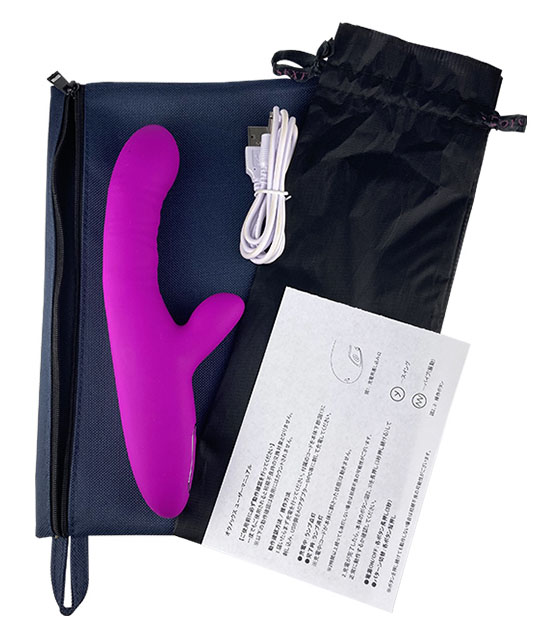
It’s available from Love Trip for \8,970 (tax included, free shipping).
Masturbate in a Private Space
For those who haven’t experienced internal orgasms yet, it’s best to masturbate in a private, comfortable space.
Visiting women-focused erotic massage salons or adult entertainment services, like Lips, can create an ideal environment and increase arousal, making internal orgasms easier to reach.5
On the other hand, if you feel anxious or distracted, internal orgasms become more difficult.
For example, it’s hard to focus in a room at your parents’ house without a lock, where someone could walk in anytime.
In such cases, using a women-only capsule hotel can help secure privacy.
Other options include rental rooms, solo love hotels, or business hotels—any place where you can feel relaxed, safe, and fully immerse yourself in pleasure.
Increase Your Arousal
Sexual arousal is crucial for internal orgasms.
First, you need to raise your level of excitement.
You can boost arousal by moaning, using visual stimuli, or exploring erotic content—like your favorite adult videos, magazines, or e-books.
Start by stimulating your clitoris to get aroused, then move on to G-spot stimulation.
Sometimes, simply hearing your own moaning can significantly increase sexual excitement.
When your body is already aroused, other erogenous zones enhance the sensitivity of your G-spot.
The ideal state is when your vagina is well-lubricated and other erogenous zones—like your nipples and clitoris—are fully sensitive.
Consider Applying to Lips
Up to this point, we’ve introduced self-exploration techniques for the G-spot.
From feedback by women who have applied to Lips, many report:
I can’t really figure it out on my own

It feels good, but I always hit a wall at a certain point
For women aiming for internal orgasms, self-exploration alone has its limits for most.
As mentioned at the beginning of this article, Lips is a women-only service dedicated to helping women achieve internal orgasms. Over 500 women have had their erogenous zones developed and guided to orgasm.
We receive applications from women for various reasons: wanting internal orgasms, seeking sexual relief, and more.
You can check the experiences of women who contributed to our testimonials on our website.
Additionally, related articles show raw feedback from women via Messenger screenshots, which may be helpful if you plan to apply.

Gain Experience With a Physically Compatible Partner
A “sexually compatible partner” is one whose erect penis length and shape fit well with your vagina.
During thrusting, the glans rubbing against the G-spot can naturally stimulate it, sometimes allowing you to reach an internal orgasm while being penetrated.
Ideally, this happens with a partner who is physically compatible and experienced.
Both penis length and the man’s experience play key roles in effectively stimulating your G-spot during sex.
Precautions When Developing the G-Spot

Before you start exploring your G-spot, there are a few important precautions you should be aware of.
Since the G-spot is located inside the vagina, and therefore inside your body, performing G-spot development in an unhygienic condition can introduce bacteria and may lead to vaginitis.
In some cases, you may need to pause G-spot development or sexual activity until fully recovered.
It’s especially important to maintain cleanliness before starting G-spot stimulation.
With these points in mind, we will now introduce the precautions you need to know before developing your G-spot.
Maintain Hygiene
Whether you are using just your fingers or toys, always wash your hands thoroughly with soap to ensure cleanliness.
Another point to check, especially when using fingers, is whether your nails are trimmed and there are no rough edges or hangnails.
If nails are too long or sharp, they could scratch the vaginal walls during G-spot stimulation, potentially causing bacterial infections.
If you have nail extensions, it’s best to avoid finger stimulation and use sex toys instead!
After G-spot development, don’t forget to clean your toys and wash your hands for hygiene purposes.
Protect Bedding and Surfaces
Depending on your body and level of arousal, you may squirt during G-spot development.
Squirting is a natural sign of heightened sensitivity and successful G-spot stimulation, so it’s nothing to worry about.
However, getting your sheets soaking wet or ruining your bedding can be problematic.
If it’s your first time, don’t stress—it’s normal.
From the second time onward, prepare in advance: place double towels, change to a bathroom setup, or take other precautions to manage squirting.
Consider Odors
Depending on your menstrual cycle or physical condition, vaginal fluids may sometimes have a strong odor.
If this bothers you, consider using a deodorizing spray.
When using fingers, odors can linger under your nails and may be difficult to remove even after washing.
Washing your hands with coffee or green tea can help neutralize odors effectively.
Privacy and Location Considerations
Although G-spot development is technically self-exploration, it is essentially similar to masturbation.
Since sexual arousal is necessary, it can be viewed as vaginal self-stimulation for pleasure.
For women living with family, ensure your moans don’t get overheard, and consider wearing a robe or gown to feel safe and covered in case someone enters unexpectedly.
Women living alone generally don’t have this concern, but those living with a partner or whose partner has a spare key should take similar precautions.
What to Do If You Struggle with G-Spot Development

Sexual pleasure is something you learn through experience, but it’s also something your brain memorizes as “this feels good!”
You don’t need to give up just because it doesn’t work on your first or second try.
Developing your G-spot requires practice and experience.
Here, we will introduce specific strategies for when G-spot development doesn’t go smoothly.
Find a Private, Comfortable Space
If you live with family or in a shared house, it can be difficult to secure a truly private space.
Masturbating with the goal of achieving an internal orgasm can take time, and you may also be concerned about moaning or the vibration sounds of a toy.
In an environment where you constantly worry about your surroundings, G-spot orgasms can be much harder to achieve.
Focus on Vaginal Stimulation, Not Just the Clitoris
Shift from masturbation that relies solely on clitoral stimulation with toys like wand massagers or small vibrators to a masturbation style that uses a G-spot–stimulating vibrator with clitoral functions to stimulate the inside of the vagina.
Instead of focusing on clitoral orgasms, focus on pleasure from vaginal stimulation.
Identify Why You Might Not Get Wet Easily
Even if you know where your G-spot is, stimulation will not lead to pleasure if your vagina is not naturally lubricated with your own vaginal fluids.
Being properly lubricated indicates that your sexual arousal is high, which allows your G-spot to become sensitive and function as an active erogenous zone.
If you have trouble getting wet, there is usually a physical reason, such as poor circulation or feeling cold.
Frequently Asked Questions About G-Spot Development

- QDoes the G-spot really exist?
- A
I personally believe the G-spot exists. Many women who have visited our clinic, Lips, report feeling a pleasurable spot a few centimeters inside the front wall of the vagina (toward the navel).
The exact sensation and perception of pleasure can vary from person to person.
- QI don’t feel anything when stimulating my G-spot. Does that mean I don’t have one?
- A
Sensitivity to the G-spot varies greatly among individuals. Simply touching it casually often won’t be enough to detect it.
If the G-spot hasn’t been “developed,” or if you’re tense, not in the right mental state, or not sufficiently lubricated, it can be difficult to feel pleasure.
Many women find that gradual and consistent stimulation, combined with relaxation, increases sensitivity over time.
- QIs it normal to have an internal orgasm from the G-spot?
- A
Some women find it easier to orgasm from G-spot stimulation than others.
It’s not something everyone experiences, and compared to clitoral stimulation, it can be more challenging.
The most important thing is to enjoy the process rather than focus solely on the outcome.
- QAre there any recommended sex toys for G-spot development?
- A
Curved vibrators or dildos, like the Oknox we introduced earlier, are highly recommended.
Choose toys that gently press and massage the shallow areas of the vagina rather than forcing deep insertion.
Summary
The existence of the G-spot is still debated among researchers, with opinions divided between supporters and skeptics.
As the founder of Lips, having guided over 500 women to internal orgasms, I am firmly in the pro-G-spot camp.
Based on my experience, I have shared methods for developing the G-spot.
Keep in mind that G-spot development takes time and effort.
It’s essential to shift from masturbation that focuses only on clitoral orgasms to masturbation that stimulates and develops sensitivity inside the vagina.
Adopting the mindset that “vaginal stimulation feels good” is key. Visiting a specialized service like Lips can help, but self-development should come first.
Take your time, don’t give up, and start by exploring your G-spot through masturbation.
Once you achieve internal orgasms, many areas of your body can become erogenous zones.
If you’ve made progress or are struggling, visiting a professional service like Lips can guide you toward achieving internal orgasms.
References
In this article, we also include expert research on female orgasms to provide an objective perspective.
- Female G-Spot (Anatomy.app) ↩︎
- Study on Nerves and Blood Vessels in the Anterior Vaginal Wall (Peking University First Hospital) ↩︎
- Does the G-Spot Exist? (International Systematic Review) ↩︎
- Anatomical Study of the Clitoris (O’Connell, 2005) ↩︎
- Study on Female Sexual Response Models (Basson, 2001) ↩︎
Notes
- Anatomy.app provides educational illustrations of the G-spot’s location and structure for medical students.
- The Peking University study indicates a high density of nerves and microvessels in the distal third of the anterior vaginal wall, suggesting a possible structural basis for the G-spot.
- A systematic review from Europe and North America compared 31 studies, concluding there is no consistent anatomical structure that can be definitively called the G-spot.
- Dr. O’Connell (Australia) reported that the clitoris has internal structures that connect to the vagina.
- Dr. Basson (Canada) proposed a female-centric model of sexual desire, focusing on responsiveness to stimulation rather than a male-centered model.